Research

Physics-led inversion. Reliability you can interrogate.

My research connects active-source seismology, crustal imaging, scientific machine learning, and uncertainty quantification. Each programme is framed around a physical question, a traceable method, and a test of what the data can truly support.

01

Full-waveform inversion · Scientific ML

Reliability-calibrated deep residual FWI
Submitted to Computers & Geosciences
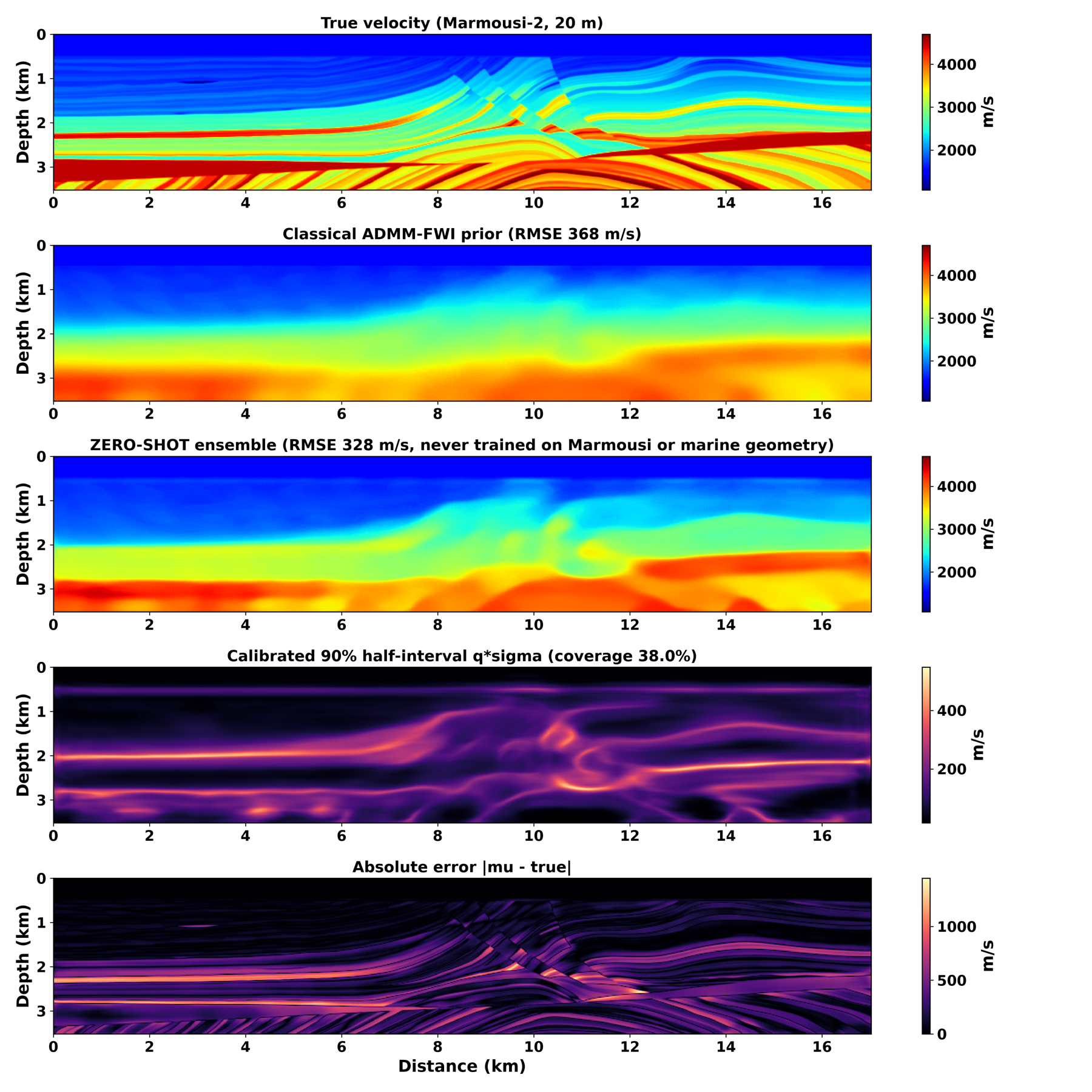
Marmousi-2 velocity model, classical FWI prior, zero-shot ensemble result, predictive interval width, and absolute error.
Zero-shot Marmousi-2 evaluation: true velocity, classical prior, residual ensemble, calibrated interval width, and error structure.

The problem

Gather-based neural inversions can memorize acquisition geometry and remain overconfident when survey layout, noise, or wavelet properties change.

The method

Variable geometries are mapped into a fixed model-space representation built from a starting model, classical inversion, FWI gradients, illumination, and wavenumber-coverage maps. A heterogeneous ensemble predicts residual corrections and calibrated intervals.

The outcome

Across 1,000 synthetic models and six acquisition families, the ensemble reduced error by 38% relative to its classical prior. Zero-shot Marmousi-2 testing reduced error from 354 to 304 m/s, while a physics audit repaired interval coverage under eleven corruption conditions.
02

Wide-angle seismology · Uncertainty

How firmly is the Dharwar Craton Moho constrained?

Submitted to Geophysical Journal International
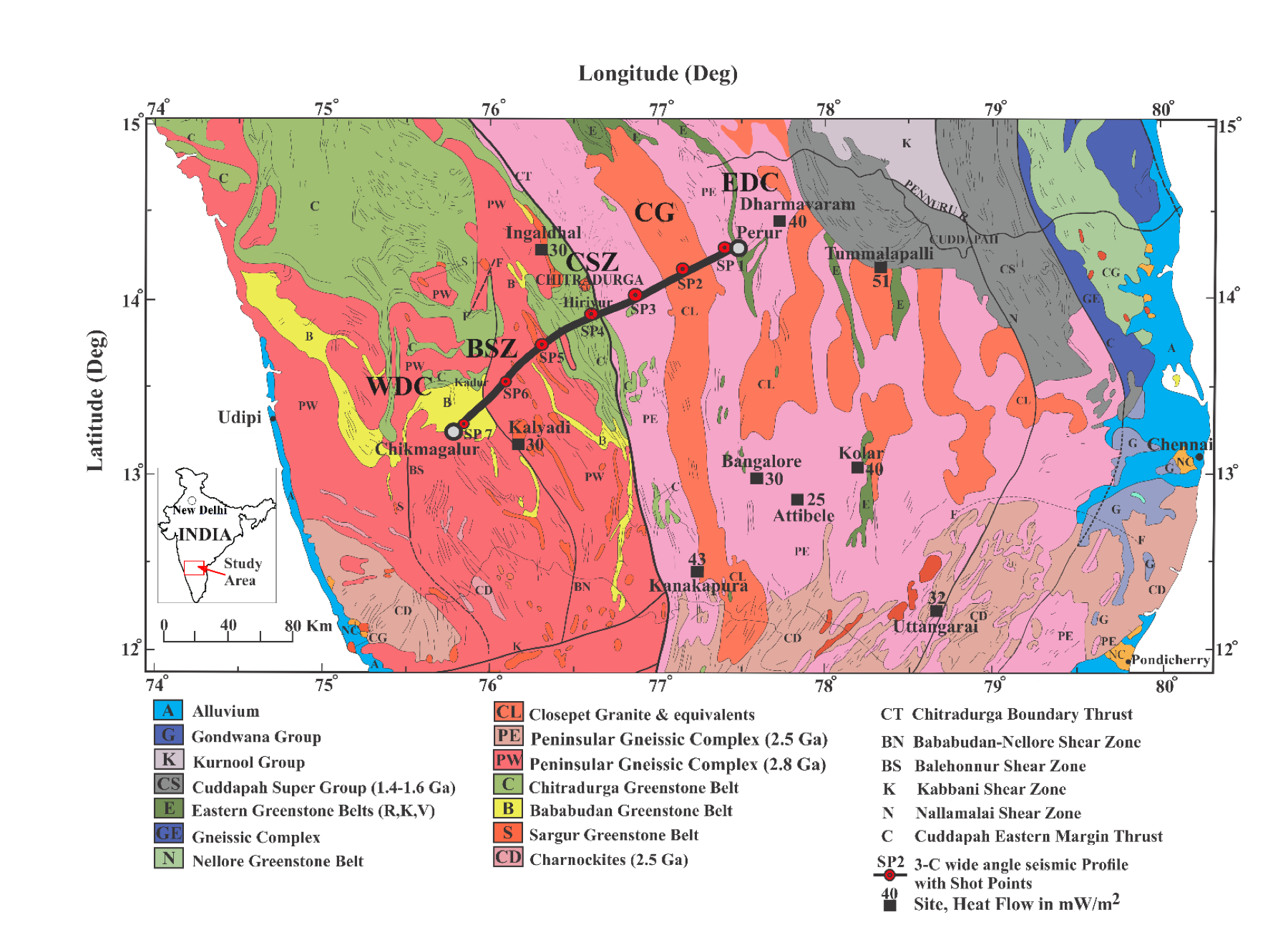
Geological map of southern India showing the Perur-Chikmagalur wide-angle seismic profile and shot points across the Dharwar Craton.
The 210-km Perur–Chikmagalur 3-C wide-angle profile crosses the western and central Dharwar Craton.

The problem

Uncertainty estimates derived from a single picking error can miss dependence within shot gathers and the larger velocity–depth trade-offs that act at model-class scale.

The method

The workflow combines nested complete-shot validation, a receiver-coordinate block bootstrap, reflector refitting, synthetic recovery, and a broad family of admissible velocity models.

The outcome

The analysis uses 2,000 primary first arrivals and 9,919 reflections from seven shots, with 852 later-turning observations held out. It reports sampling and model-class uncertainty separately rather than compressing both into one interval.

03

Acoustic impedance · Sparse inversion

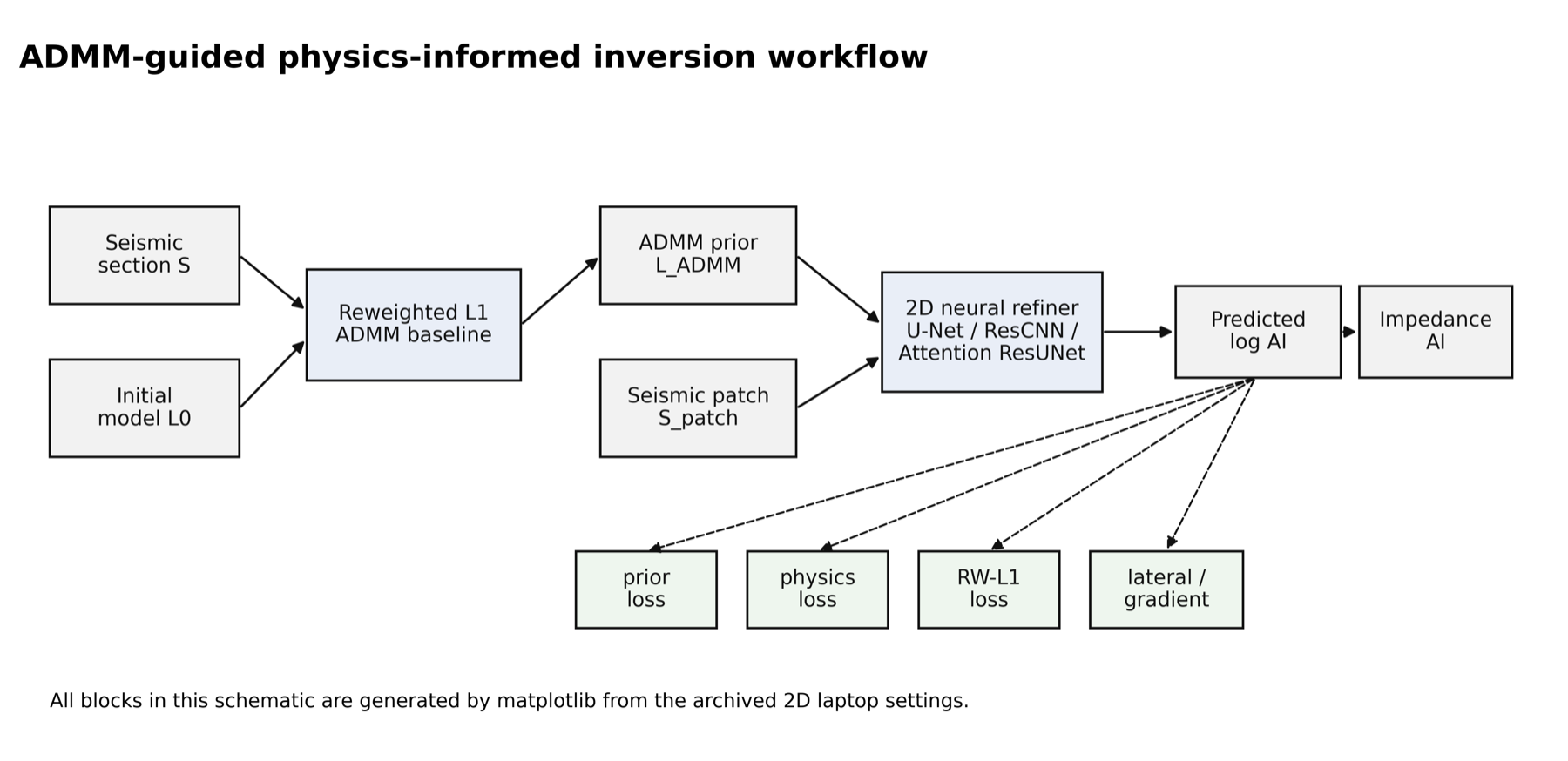
ADMM-guided physics-informed deep learning

Submitted to IEEE TGRS
Workflow diagram for ADMM-guided neural acoustic-impedance inversion with physics, sparse regularization, and model updates.
A physically traceable loop connects seismic data fit, reweighted sparse regularization, and learned model updates.

The problem

Post-stack impedance inversion is ill posed: band-limited seismic data permit many models, while unconstrained learned methods can create plausible but weakly supported structure.

The method

The workflow alternates physically interpretable inverse updates with sparse regularization and a neural component designed to recover structurally coherent impedance rather than replace the forward model.

The outcome

The study tests one- and two-dimensional examples, clean and noisy conditions, and multiple neural architectures while keeping the physical data-fit term explicit.

04

3-C seismology · Crust–mantle structure

Velocity, composition, anisotropy, and the Hales discontinuity

Under review at Gondwana Research
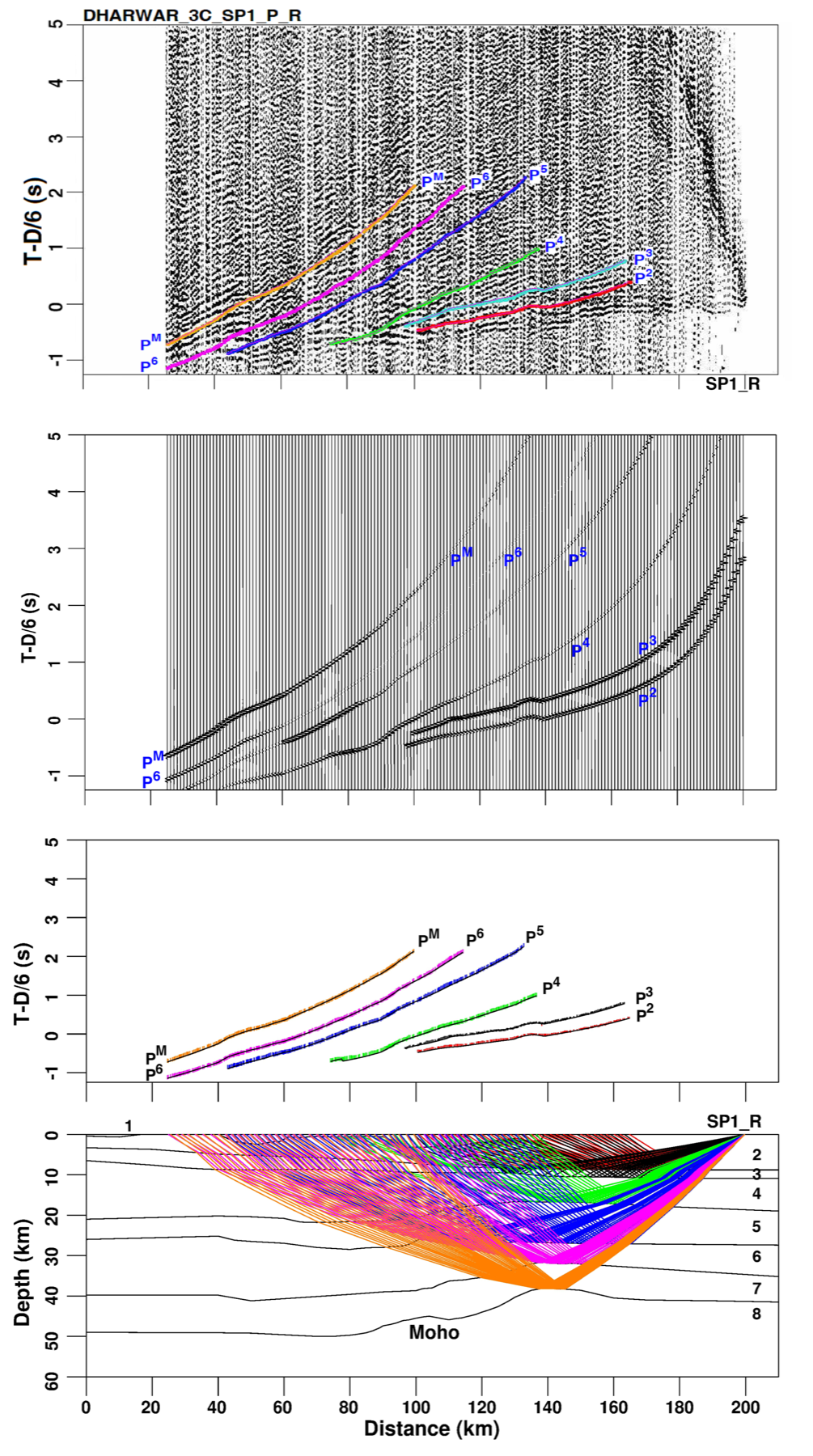
Wide-angle seismic record section, picked phases, calculated travel times, ray paths, crustal interfaces, and Moho beneath the Dharwar Craton.
Observed and calculated wide-angle phases constrain a layered crustal model and the Moho along the profile.

The problem

Crustal composition and mantle structure cannot be resolved reliably from a single phase or property; converted and shear-wave evidence adds critical constraints.

The method

Phase picking, ProMAX processing, ray-based inversion, P/S velocity modelling, and anisotropy analysis are integrated along the Dharwar Craton profile.

The outcome

The work produced P- and S-wave velocity, Vp/Vs, Poisson’s-ratio, composition, and anisotropy models and examined evidence for the Hales discontinuity and upper-mantle low-velocity zones.

Current research setting

High-latitude lithosphere and multi-method integration

At IGF PAN, I work with active and passive seismic observations, inversion, anisotropy, and geodynamic context to study crust and upper mantle structure—including projects focused on Spitsbergen.

  • Phase picking and quality control
  • Active- and passive-source integration
  • Velocity and anisotropy modelling
  • Crust–mantle interpretation
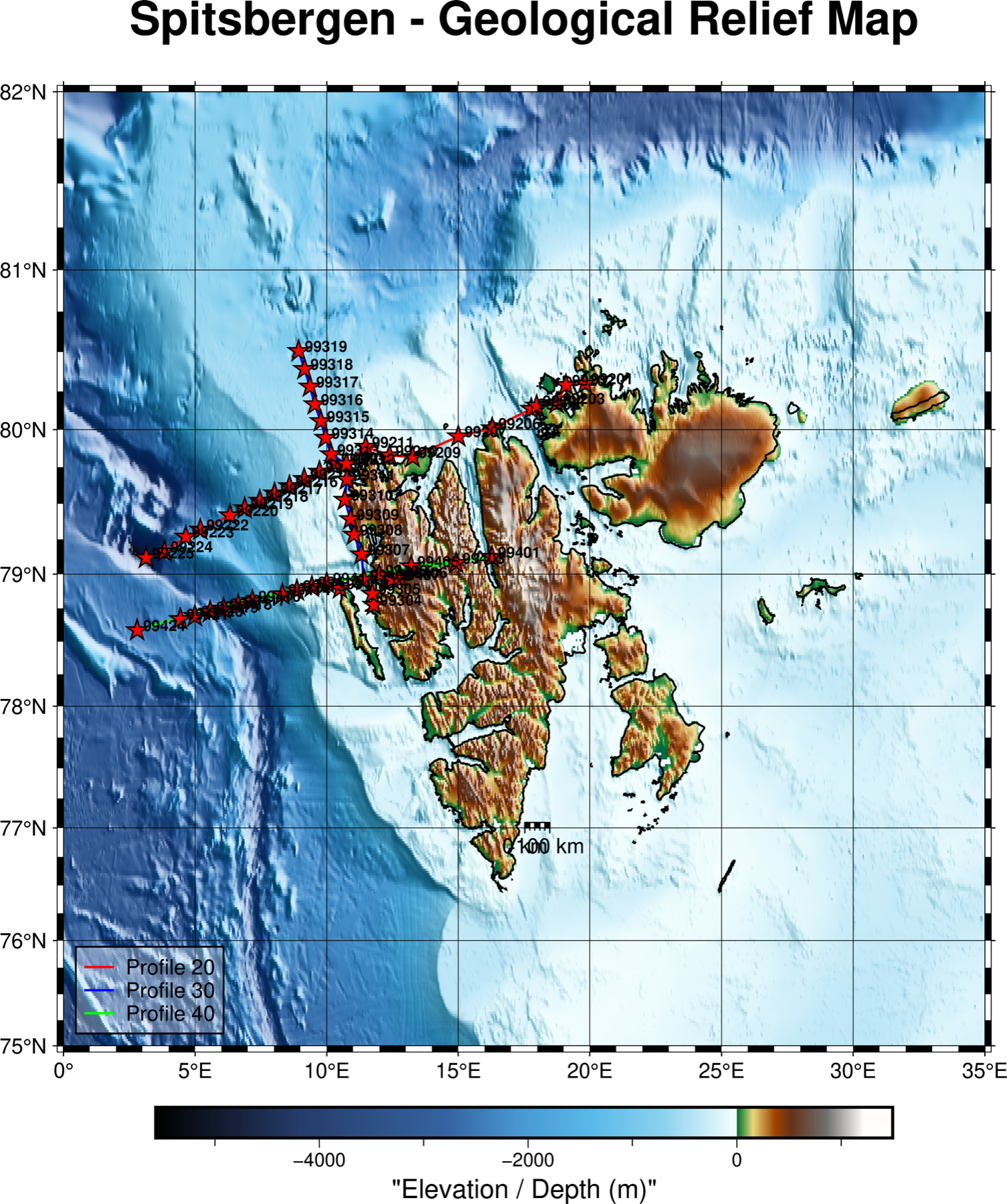
Map of Spitsbergen and surrounding bathymetry with geophysical profile locations
Regional setting for lithospheric studies around Spitsbergen.

Technical range

A connected subsurface toolkit

Methods are selected for the physical question and available evidence—not because one algorithm should solve every scale.

01

Seismic imaging

2-D, 3-D, 3-C, active-source, passive-source, and wide-angle processing and interpretation.

02

Inversion & modelling

FWI, tomography, acoustic impedance, ray tracing, velocity-model building, depth imaging, gravity, and heat flow.

03

Scientific machine learning

Physics-informed learning, residual ensembles, CNNs, conformal calibration, and sparse regularization.

04

Exploration & E&P

Horizon and fault interpretation, well ties, reservoir characterization, hydrocarbon-trap evaluation, and CCUS risk workflows.

05

Reliability

Held-out prediction, acquisition-shift testing, block bootstrap analysis, model-class trade-offs, and reproducible computation.

06

Technical leadership

Team leadership, stakeholder communication, international collaboration, mentoring, workshops, and invited teaching.